


I've always been a huge fan of Douglas Adams. In an interview, he once described a stint living in my home state of New Mexico and passing “existential” signs along the road that read, “Gusty Winds May Exist.” To this day, I think of him and crack a wry smile every time I see one of those road signs. His book, The Hitchhiker's Guide to the Galaxy, is still the gold standard for me, not only for its humor, but also for its wisdom.
The Hitchhiker's Guide has the words “DON'T PANIC” in large, friendly letters on the cover because it “looks insanely complicated to operate” (and to keep its readers from panicking). I titled this article with those same words, for the same reasons. Nearly everywhere I look, I see that people are anxious, and for a lot of reasons. In our industry, they're mostly anxious about AI. I subscribe to a variety of sources that keep me up to speed on the latest in AI, and the stories are all extremely sensationalized, and panic-inducing. “AI Company Blah Is Totally Cooked,” “You're Using AI wrong!” “Technology Blah Is Dying,” “Death of the Software Engineer,” and “Stop Doing Blah, Start Doing Blah.” Don't fall for it.
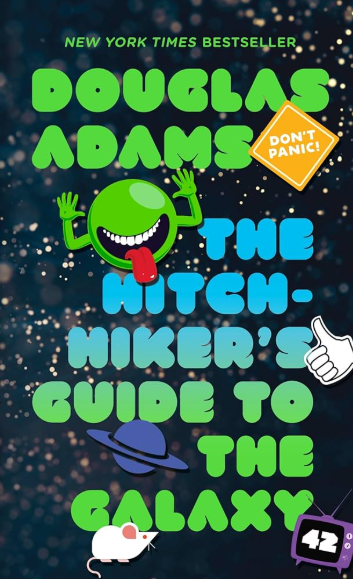
I sometimes find myself caught up in the hysteria. When I do, I remind myself: DON'T PANIC. Then I make sure I know where my towel is. Finally, I do a reality check. Yes, some companies are in the news making huge staffing cuts, but if we look past the headlines, it's not exactly the apocalypse and there is no sign of plans for a hyperspatial express route yet. I have the good fortune to work with a lot of companies, in addition to my own, that are doing significant work with AI. You may have seen the demo I saw about a system that autonomously looks for GitHub issues, writes tests, generates code fixes, and then submits pull requests. Fully automated software maintenance that only requires a quick human approval as a safeguard. I've since had a chance to speak with senior developers who work there and just asking how it's going generates eye rolls worthy of an angsty teenager. Yes, it does often work as desired, but in doing so, it sometimes creates more work for the reviewer than if they'd just done the work themselves. Sometimes, it doesn't work at all. Other companies laid off staff in favor of AI but are now quietly hiring them back. Still other companies are sticking to their guns and not hiring back but seeing quality decline and choosing to live with it. At least once a day the news headlines that come up on my browser have a photo that's either AI-generated, or AI-selected that's completely unrelated to the story. AI slop.
I'm not saying you should ignore AI. Quite the opposite. Some AI is quite good. Some AI is actually better than most humans at some things. I use AI every day. I use it for research, but I verify the results. Just this morning I found a handy Azure PowerShell command for copying a database across Azure tenants. If only it were true! The source material actually said it doesn't work across tenants. I used the clunky method described in the article. Problem solved. I use AI for mundane tasks. If I never have to write a job description again, it'll be too soon. I'm happy to review what AI spits out and post it. I use AI for coding. It's great for summarizing what some existing legacy code actually does, even if it's written in a defunct 30-year-old language. AI is fantastic at helping me figure out how to write a new function in C++ (which I haven't seriously done since the '90s). AI is terrific at writing code to “read a JSON file and copy the following values out of it into MyClass in C#.” Yes, I can write that code… again… but AI can do it faster and without straining my brain to remember which overload of that method eliminates duplicates automatically. And then sometimes it keeps trying to help me while failing miserably and wasting hours while being completely self-confident the whole time. Overall, it saves me time.
AI is good. But it's not that good. Yet. Looking at what AI can do today, what it could do last year, what it could do the year before that, and the year before that (and that's really as far back as generative AI goes), it has improved at an astounding pace. I believe it will keep improving at an astounding pace for some time. Am I worried? No. I'm keeping up with it and using it in a rational, adult capacity. Has it changed my work? Yes. Has it eliminated my work? Not even a little bit. For every bit of time I save, there's some new work to take its place. I find solace in Marvin, Douglas Adams's sentient robot. Far beyond the level of AI we can now create, but also deeply flawed and clinically depressed, Marvin famously said, “Why should I want to make anything up? Life's bad enough as it is without wanting to invent any more of it.”
Be like Marvin. Don't make things up in your head. Remember: the one and only goal of the headline and the image of Tilly Norwood is not to inform you. It's to get you to click on it. Nobody's going to click on a headline that reads, “Incremental Improvements in Model Blah!” If you still find yourself anxious, try to remember that we here on Earth are “mostly harmless.” Don't fall for the hype. The reality is far less dramatic. DON'T PANIC.
